John HenryThe platform
The Attorney Plug In

Decide whether you want the case without receiving what would disqualify you.

A lawyer you know has a matter they cannot keep. To work out whether you want it, the ordinary route is to let them tell you — and Tex. Disciplinary R. 1.18(c) turns on what you received, whether or not you took the case.

Then, two years later, the other side moves to disqualify you and the question is what you heard on a phone call nobody recorded.

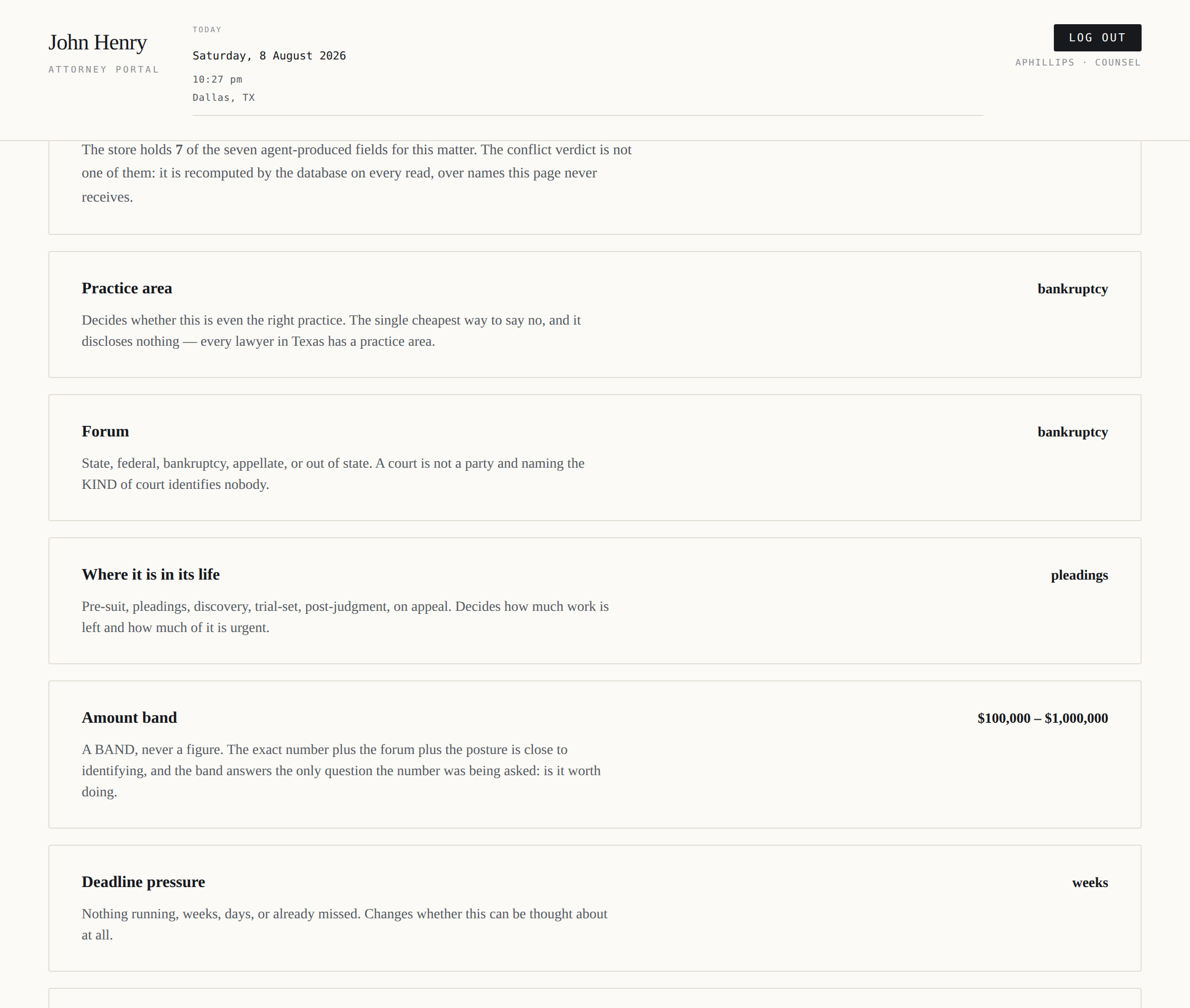
The Attorney Plug In — the eight shorthand fields, each with the reason it is safe to show, and the note saying what was withheld
The shorthand — a real render, not a mock-up. Eight fields, every one an enum or a band, each carrying the reason it is safe to show. The matter is invented.
Why your firm cannot build this internally

Imputation. A screen inside one firm is a policy enforced by memory.

The paralegal who reads the file is a person, and what that person knows is imputed to the firm. Put a wall between them and the partner and you have a procedure — one that has to be followed, remembered, documented and then defended by the people it constrains.

A platform is a different kind of thing. It can hold information that no lawyer at your firm has ever received, reason over it, and answer a narrow question about it without any of it crossing to a human here. That difference is structural rather than procedural, and it is the reason this feature exists on a platform and not in a policy manual.

How it runs

Four steps, and the order of them is the security.

The conflict screen runs first, before a single question is asked

Not for efficiency. Every question the agent asks produces an answer the platform then HOLDS, so screening last would fire the screen after the damage it exists to prevent. The system refuses to proceed until the screen has run, and the build fails if screening ever stops being step one.

The referring lawyer answers, on their side of the wall

They sign in against their own invitation and find the barrier agent's questions waiting. Every answer lands sealed. The usual conferral is inverted here: the agent asks the lawyer who actually holds the file, so nobody at this end is asked anything and nobody at this end receives anything.

You read eight fields

Enums and bands. Not one free-text box, anywhere, by design. A prose summary written by a model is a leak waiting to happen — not because the model is careless but because its instinct is to be helpful, and the helpful detail is precisely the disqualifying one.

You choose a door, and it says which ones are one-way

Look is reversible. Take spends the barrier, and nothing afterwards un-receives what crossed. Pass is also final — and the record of what never crossed is the asset, because it is what answers a disqualification motion two years from now. A database trigger refuses to re-raise a barrier that has been opened; a barrier that can be reset is a record that proves nothing.

The shorthand

Eight fields, and the closed list is the first wall.

A helpful referring lawyer who wants to type the style and the cause number into a “notes” box has nowhere to put it. And a name smuggled INTO an allowed field — “suit against Toby Haldeman” typed into the practice-area box — is refused on its shape, not on its length. Either wall on its own leaks.

FieldWhat it may contain
Practice areaAn enum. Not “commercial litigation against a Dallas homebuilder”.
PosturePre-suit, filed, tried, on appeal, post-judgment.
Forum kindState district, county court at law, federal, bankruptcy, appellate.
Amount in controversyA band, never a figure. A figure is often the case.
Age of the matterA band.
Why they are referring itA closed list: conflict, capacity, jurisdiction, subject matter, fee structure.
Conflict screen resultClear, match, or not yet screened — and never WHICH name matched.
Document countHow much file there is, so you know what taking it costs.
The finding that surprised us

A question is an assertion.

“What is the appellate cause number” says there is an appeal. “Who signed the supersedeas bond” says there is a bond and that somebody signed it. “Is the receiver still in possession of the Rains County tract” discloses a receiver, a county and a tract in nine words.

Every one of those was written by an agent that read a file this firm may not read. So the question list leaks through the one artefact nobody thinks to screen — and it is a WORSE leak than the answers would be: short, in prose, and reading as administrative rather than as substantive.

The questions are therefore sealed on the same terms as the answers, and there is no insert permission for anybody signed in at this end — including this firm. A question this firm could author is one it could only have written from knowledge it would first have had to receive. The opening questions are the ones that are identical on every matter, and that constancy is the entire reason they are safe: an opening question could have been written before the matter existed. Anything that varies with the file came from reading the file, and the build refuses one that names a party or carries a figure, a cause number, a date or a theory.

The general rule, if you are evaluating any tool like this

Enumerate everything that CROSSES, not everything that is stored. A request, a receipt, an error message, a progress bar and a question all cross. Ask of each one: could this have been written without reading the protected side?
The caveat, and it belongs on the front of the product

This reduces Rule 1.18 exposure. It does not eliminate it.

Whether a platform reasoning over sealed data counts as the firm having received that data is unsettled, and anybody telling you otherwise is selling you something. What can be said is narrower and more useful: the structured shorthand is what makes the argument defensible. A prose summary would give it away, which is why there is not one.

What you are buying is not immunity. It is a contemporaneous, append-only record of exactly what crossed to you and what did not — produced before the dispute existed, which is the only kind of record that is worth anything when it arrives.

The first firm to use it is the one that finds what nobody inside could see.

Access is opened one practice at a time. Tell me what you would put on it first.

Request accessWhat happens next