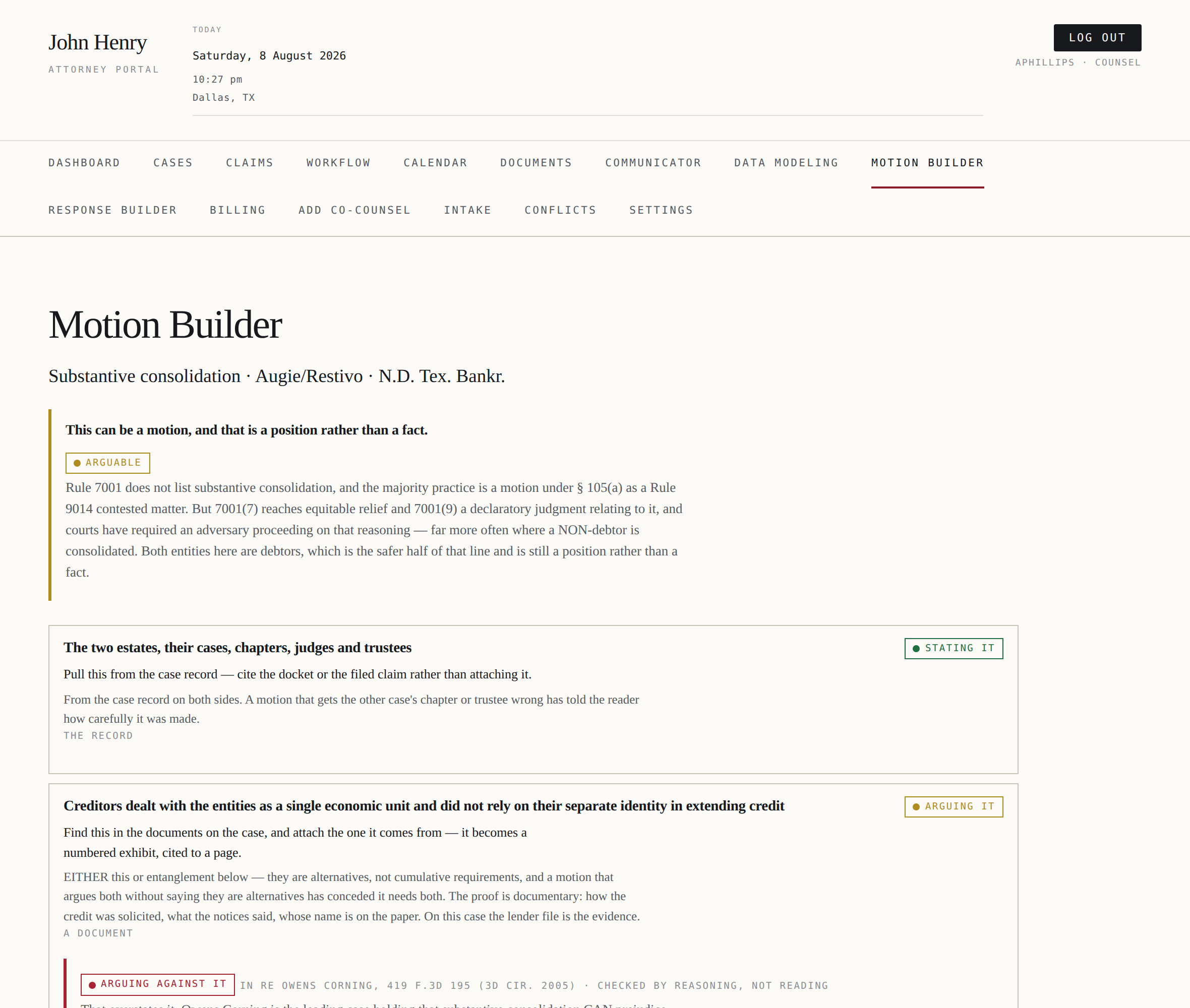
A motion is a set of elements, each with a source, a burden and something that has to prove it.
So that is how it is built. You pick the forum, the relief and the theory; the
elements follow from those, and the document is assembled from what you actually
answered. Nothing in it asserts a fact that nobody typed into an element.
A real render, not a mock-up. The contested-vehicle warning on Rule 7001, then the elements — the drafter's grade on each card, the authority pass's finding underneath. The matter is invented.
The catalogue
Two registers on one card, because a beginner mode is a motion with the traps taken out.
5 forums, 46 kinds of relief, 65 theories and 187 elements — and every element carries the source it rests on, the proof it needs, a practitioner's statement of it and one plain instruction derived from the other two.
The intended reader is a managing partner with twenty years of bankruptcy practice
AND the associate down the hall. A “simple mode” would mean those two people are looking
at different motions, and the associate's is the one missing the parts that bite. So
every element card carries the practitioner's statement, one plain instruction derived
from that element's own source and proof — which means it exists for all of them and
cannot drift — and the practitioner's note.
The cascade is the order a lawyer actually works in: what the case and the parties
already say, then the documents on the file, then your own firm's templates on that
subject, and only then a search of authority to confirm the path you already took. When
your firm has no template for a subject the tool says so outright rather than reaching
for somebody else's.
The one refusal
Rule 7001 is a hard stop, and it has three answers rather than two.
Fed. R. Bankr. P. 7001 lists ten proceedings that must be brought by adversary
complaint. Drafting a motion for one produces a paper that is defective on its face and
no amount of argument cures it — so this is the only place the builder refuses outright.
Red refuses. Turnover from someone other than the debtor is an adversary
proceeding; from the debtor it is a motion, on the 7001(1) exception. The check reads
the THEORY rather than the relief type, because the relief type is not the thing that
knows.
Yellow says the vehicle is contested and names both readings. Substantive
consolidation is not listed in 7001, majority practice is a § 105(a) motion under Rule
9014, and 7001(7) and 7001(9) have a real claim on it — much stronger where a
non-debtor is being consolidated.
Green says nothing disturbs a contested matter.
The worked example it was built on
An omnibus claim objection cannot carry a usury theory. Rule 3007(d)'s permitted
grounds are a closed list and a substantive ground is not on it, 3007(e) caps at a
hundred claims, and 3007(b) forbids joining Rule 7001 relief to an objection. So
disallowance under § 502(b)(1) is a contested matter, recovering the excess is
7001(1), and subordinating under § 510(c) is 7001(8): one theory, three papers.
The Response Builder
A response does not choose what it is about. The movant did.
So there is no relief picker. The elements are the movant's, read off
the relief they served, and what you supply for each is a POSTURE — denied, disputed on
the facts, admitted, legally insufficient, affirmative defense, or no position.
Building it the obvious way, with a relief chooser, produces a tool that drafts a
cross-motion every time somebody meant to file an objection. And there is no default
posture: a default of “deny” would have the software take a litigation position, and
would make an untouched response look like a complete denial of everything.
The burden flips per element, and the card says whose it is. Denying an
element the movant must prove needs only that the record does not support it. An
affirmative defense needs your own evidence, your exhibit and somebody to swear to it.
A tool that treats those alike promises proof you never had to produce, or fails to
produce proof you do.
“No position” is a thing you say, not a blank you leave. A trustee takes no
position on parts of a motion all the time, and saying so is different from failing to
reach it. The document prints it.
Silence on an element is usually taken as agreement with it. That sentence
leads the page, above anything encouraging, because on a screen of filled-in boxes
nothing else says so. The untouched elements are counted and listed by name.
Asking for something back is a cross-motion
Whatever the caption says. Buried in a response it gets no notice period of its own
and no hearing convened for it — so affirmative relief is refused, and the refusal
names the second document you actually need. An affirmative defense is NOT a
cross-motion, and keeping those apart is the point: a check that flagged every
limitations defense would be switched off inside a week, and then the real refusal
would not reach anybody either.
Deadlines
Two rules, seven days apart, and the comparison is the warning.
In the Northern District of Texas, Local Rule 9007-1 gives fourteen days where the
motion carries a negative-notice legend, and 9013-1 gives twenty-one for an ordinary
opposed motion. The legend says relief is granted WITHOUT A HEARING if nobody objects in
time, so the shorter window is the one with teeth — and a response calendared off the
twenty-one-day rule against a negative-notice motion arrives after the order.
Both numbers are always shown together. The page asks which applies and reads “not
known yet” until somebody answers, because a default there is the tool guessing at the
one number it must not guess at. Both were read out of the court's own PDF and are
re-checked monthly against a content hash; a change raises a row on the board rather
than overwriting quietly.
Drop a served pleading in and the caption reader will find the legend for you — it
requires two independent phrases rather than one, so a motion that happens to mention
acting without further notice about something unrelated is not handed a deadline it does
not have. Finding the legend does not SET the deadline. The parser's job ends at “these
words are on the page”; what they do to a date is a legal consequence and a separate
function.
The document
Nothing in the paper asserts something no element carries.
Every factual sentence in the generated motion is one somebody typed into an element,
quoted back. A generator that writes connective prose writes assertions, and an
assertion nothing in the record supports is a Rule 9011 problem with your name under
it.
An unanswered element is PRINTED, as a bracketed gap carrying its own instruction —
never omitted. A motion missing its third element and one that never needed a third look
identical on paper, and only one of those is finished. Word and PDF, Letter, one-inch
margins, Times New Roman 12, and 28 U.S.C. § 1746's fixed perjury wording written out in
full — while local form is a marked gap that names the rule and says it is unconfirmed.
A text may be asserted; a local practice may not.
Outcomes attach to elements rather than to motions, because “this element carried, on
this evidence, before this judge, over this objection” is the reusable fact. A denial for
want of a certificate of service says nothing about the motion, so preventable defects
are a separate column excluded from every merits rate and reported as their own
number.
The part other vendors leave out
And here is what it refuses to do.
Read this before the feature list, not after it.
Nothing files and nothing signs.
There is no CM/ECF integration and there is no e-signature. Recording a motion as filed is a snapshot you take after you filed it yourself. A tool that files is a tool that can file the wrong thing at 4:59 on a Friday.
No case ever goes green off a model.
A model may assert a TEXT — a statute, a national rule — because you can confirm it in fifteen seconds against a free authoritative source. It may never settle what a case HELD. A case citation from a model pass tops out at arguable, and the ceiling is enforced where the card is stored rather than asked for in a prompt, because a rule a model is asked to follow is a rule it can fail to follow silently.
The sources it cannot reach are listed, switched off, by name.
The research panel names the judges' standing procedures, the docket and the full text of the decisions, and says NOT CONNECTED beside each. A panel that lists only what a tool has tells you it consulted everything it has.
It will not give you a deadline as a date.
It returns a number of days and the rule the number came from, and where two local rules answer differently it shows both, because the comparison is the warning. Rule 9006 counting, service-method additions and court holidays are not modelled, and a date printed with confidence is one a lawyer stops re-checking.
It does not read a scan.
A served pleading with no text layer is reported as probably a scan, which is not the same claim as the document being empty. The caption in a picture is a picture.
It will not take a litigation position for you.
A response has no default posture, because a default of deny would make an untouched response read as a complete denial of everything. Whether a matter is core and whether you consent to entry of a final order are left blank — that is Stern v. Marshall, and it is a position, not a recital.
It never says a case is good law.
A citation graph proves that one case cited another on a date. It cannot tell overruled from distinguished from a string cite, and anything that renders a green flag off a citation count is the failure this whole system is built against.
It bills no time you did not spend.
Model seconds are stored as telemetry in a column the schema will not allow to be summed into a billable line — a generated column that cannot reference it, with a probe that fails the build if it ever does. ABA Formal Op. 512 and Tex. Ethics Op. 705 both hold that only human time is billable; here that is unrepresentable rather than documented.
Put a real motion through it.
The fastest way to evaluate this is to build something you already know the answer to and see where it argues with you.