Ten nouns, four tables, and a party that means the same thing in every firm on the system.
Estates, matters, cases, claims, demands, appeals, judgments, rulings, intervenors,
parties. Most systems grow a table per noun and then spend years reconciling six
answers to one question.
A case is a proceeding. An estate is what comes into existence when a bankruptcy is filed. They are not the same thing.
A bankruptcy case HAS an estate. A usury suit has none, an appeal has none, an
engagement has none. Getting that one distinction right is what lets every other noun
fit without a table each:
An intervenor is a role with a date, joined on and sometimes dismissed on. A
table for intervenors would be a second copy of the party list. A party's role is not
editable either — an intervenor who becomes a defendant is a new row on a new date.
A demand and a proof of claim are one claim in two postures. They assert the
same thing against the same party for the same money at two different moments. Two
tables would answer “what do we say they owe” twice and disagree within a month.
An appeal is a proceeding with a parent. Which buys an appeal of an adversary
proceeding, a further appeal and a remand with no ceiling. An appeals table needs
appeal_of_appeal_id inside a year.
A judgment is a ruling that is final. Finality and appealability are two
different questions, and an interlocutory order appealable by statute is most of what
gets appealed early in a bankruptcy case.
Who is IN the dispute and who may READ the file are different lists.
Opposing counsel reads and is not a party; a defaulting defendant is a party and reads
nothing. Merging those two is the mistake that looks like simplification.
A neutral is on no side, and nothing puts them on one. A trustee or mediator
quietly defaulted onto a side is how a platform manufactures an ex parte contact.
What a court entered is not editable by anyone signed in: rulings take no update
permission at all.
The party registry
Who exists is shared across every firm. Who is fighting whom never leaves yours.
A name, an entity kind, a jurisdiction and a registry file number are
public-register facts. Sharing them discloses nothing — and NOT sharing them is what
makes the same lender three unconnected rows in three firms, which is the actual
defect.
That a party is in your case is a different thing entirely. A reader learns who you
are suing and on whose behalf — client information that Tex. Disciplinary R. 1.05 reaches
whether or not it is privileged, and the thing a competitor would pay for. So case
parties, party contacts, claims and matters stay inside your firm, and a database probe
asserts BOTH halves: that the registry has no firm boundary AND that those four still do.
A check that only looked at the shared half would pass on the day somebody widened the
wrong table.
A name is not editable. On a shared registry an editable name means one firm
renaming an entity another firm's judgment is attached to. Corrections are an alias or
a merge — both additive, both reversible.
Nothing is deletable. A party is attached to service, to a judgment and to a
claim. A registry that can lose a row is one where a judgment comes to be against
nobody. A merge leaves a pointer; an undo marks the merge undone, because a merge that
was wrong is itself a fact about that entity.
A determination is not a guess, and the record says which it was. The same
file number in the same registry in the same jurisdiction IS the same legal entity, and
the registry is the authority. Similar names are a proposal a person has to accept —
the merge function cannot act on a name match at all, and a merge across two different
registry identities is refused outright however confident anybody is.
Where this is going, and what it cannot answer yet
“I have a judgment against this company — what is it worth and what can I sell it
for” is a question the registry is built to answer eventually, with a click. It needs
three things it does not have: what judgments exist against the entity, where it sits
in the creditor queue, and whether it has filed. A judgment is a public record, which
is what would make sharing it lawful — but nothing marks a ruling public yet, so
exposing them today would disclose which firm has which case. That is enumerated in
the code as NOT YET, on the page, rather than left to be discovered.
The board
Every decision that needs a person arrives as a row with a button on it.
Not on a separate approvals page. A human is required at every decision, so decisions
belong where you already look. Approving leaves a green line with your name joined live
from the profile and a timestamp to the minute; editing forks a NEW task rather than
reopening the old one; declining is its own record.
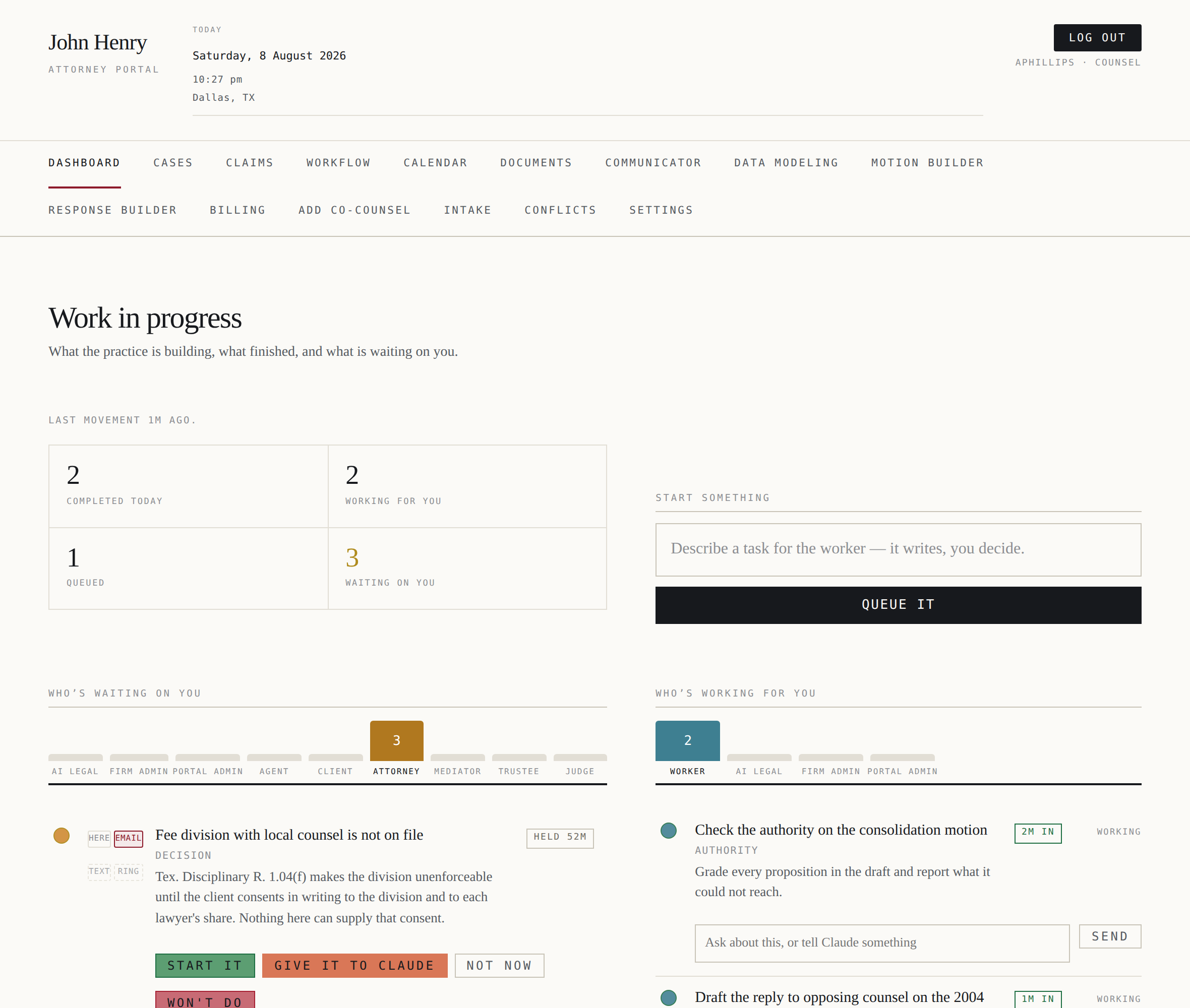
A real render, not a mock-up. Counts for today, agents on the right, decisions on the left banded by who is waiting. The matter is invented.
Who's working for you — the agents and what they are on, as one section,
because those are the same fact from two directions. A run chip says who is doing the
work, in that holder's colour.
Who's waiting on you — banded by who is waiting, escalating in colour only,
every band the same thickness. An AI agent waiting on you and a judge waiting on you
are not the same urgency and should not be the same shape.
Completed today, queued, and returned to you — counts that are for today
rather than ever, so the number means something on a Tuesday afternoon.
There is one renderer. The board the person who builds this uses and the board your
firm gets are the same module with a different connection — no private staging area
where the good version lives, and no demo build that diverges from the product the week
after it is recorded.
A guard that stops work has to say that it stopped it
The most expensive recurring defect on a system like this is not a bug. It is a
correct rule that quietly takes work out of circulation — because from the board,
“the system is working on it” and “nothing will ever touch this again” look
identical. So every rule here that removes something from a queue owes that row one
note explaining why, and the note is a kind of event that cannot advance the thing it
explains.
The communicator
Ex parte contact is not a rule the software follows. It is a thing the schema cannot represent.
A thread's audience is DERIVED from what kind of thread it is, never stored as a list
of people somebody picked. A judicial participant is a neutral, is not a mediator, and is
not a member of any participant's firm — so a firm-only thread and both halves of a
caucus are false for them, and the only kind left computes its audience from the case
participants and therefore cannot omit a party. There is no fourth kind, and adding one
would be a decision about whether this platform can manufacture a Canon 3(B)(8) problem
on behalf of a lawyer using it in good faith.
Only the mediator may convene a caucus. Caucus traffic is kept from the bench by the
same predicate, which Tex. Civ. Prac. & Rem. Code § 154.073 requires independently.
A message can be turned into a task.
Voice and video run in end-to-end encrypted rooms whose audience is the audience of
the conversation — decided once, in one place. A judge joins unable to publish. No
recording permission is ever issued, because recording is a legal decision and Texas
being a one-party-consent state does not make a multi-party call simple. The client
library is vendored at a pinned version and served from the same origin, so no
third-party script sits on a page carrying privileged conversation.
Documents and workflow
A workflow you can hand out one step at a time.
A case carries a plan with steps you assign — to your associate, to
co-counsel, to the client, back to yourself. Documents move both directions with every
read and write logged, including this firm's, and the log is yours to read. Held-back
work product is held back: the participant sees the released document and not the one
beside it.
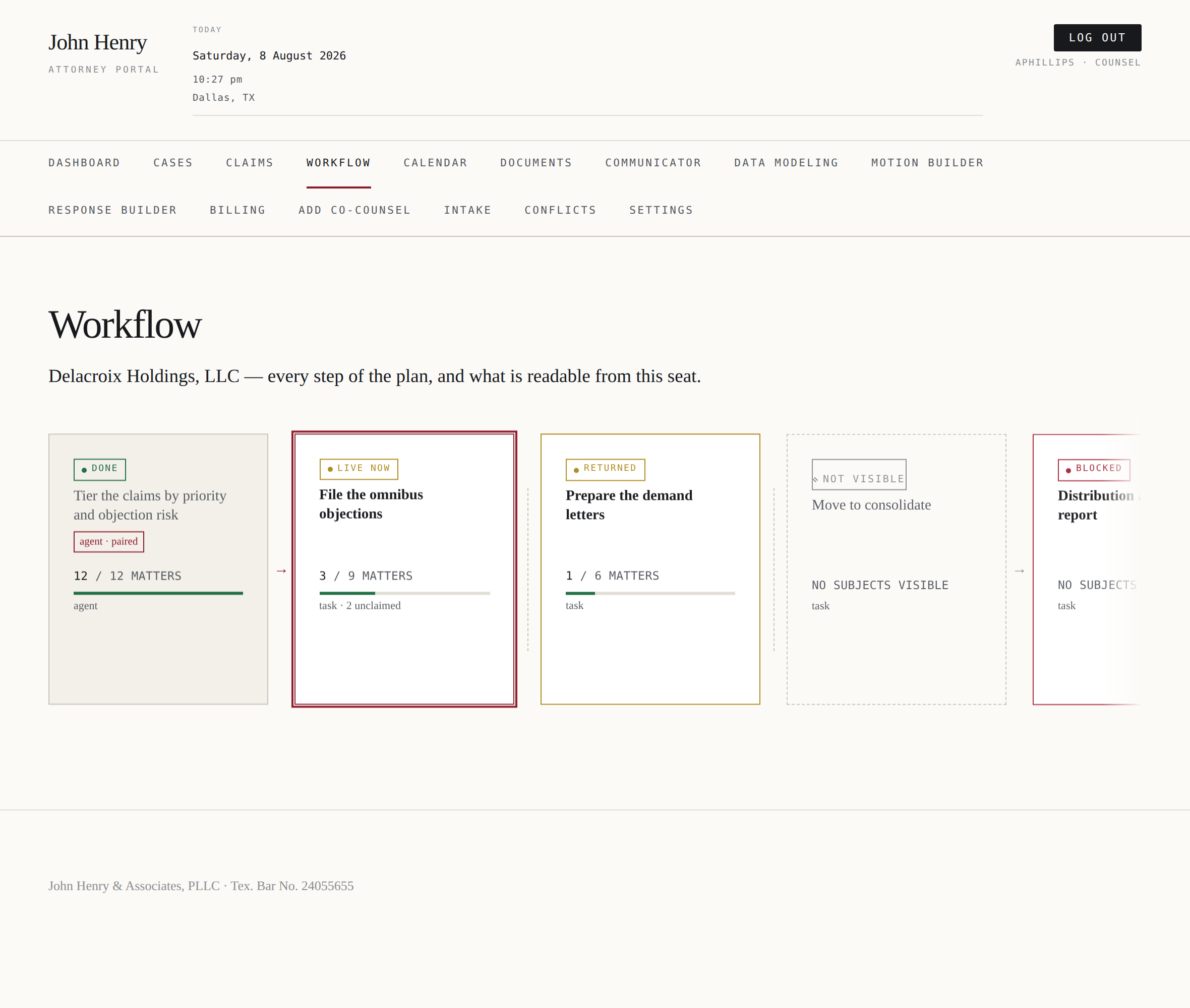
A real render, not a mock-up. Five steps in five lanes, and no arrow between the third and fourth because both fork from the tiering step rather than following each other. The matter is invented.
An arrow is drawn only where the plan has an
edge. The first version put one between every pair of adjacent cards, which asserted
an order the plan did not have — and a board that draws a sequence the case does not
have is telling a trustee something false about what must happen before what.
The honest edge, and it is on a decision row rather than hidden: every participant
sees every step's TITLE, with the unreadable ones marked “nothing on this step is
visible to you” — the last card above. The alternative — hiding the step entirely — means a count you cannot
see becomes a claim about the case derived from a fact about the reader. Which of those
is right is a judgment about client information, so it is a decision put to the lawyer
rather than a default chosen by the software.
The file is the product. Everything else is a surface onto it.
Bring a live matter. The parts that do not fit yours are the parts worth hearing about.