John Henry drafts, calendars, holds the file, talks to your client and records the time. What it will not do is decide anything. Every judgment arrives back at a person with a button beside it, and the record says which person pressed it and when.
It is built by a Texas trial lawyer against a live docket — a chapter 11, a collection matter, a judgment nobody can collect on — and shipped the same week it is written. Nothing on this site is a mock-up of something planned. Where a thing is not built, the page says so and names it.
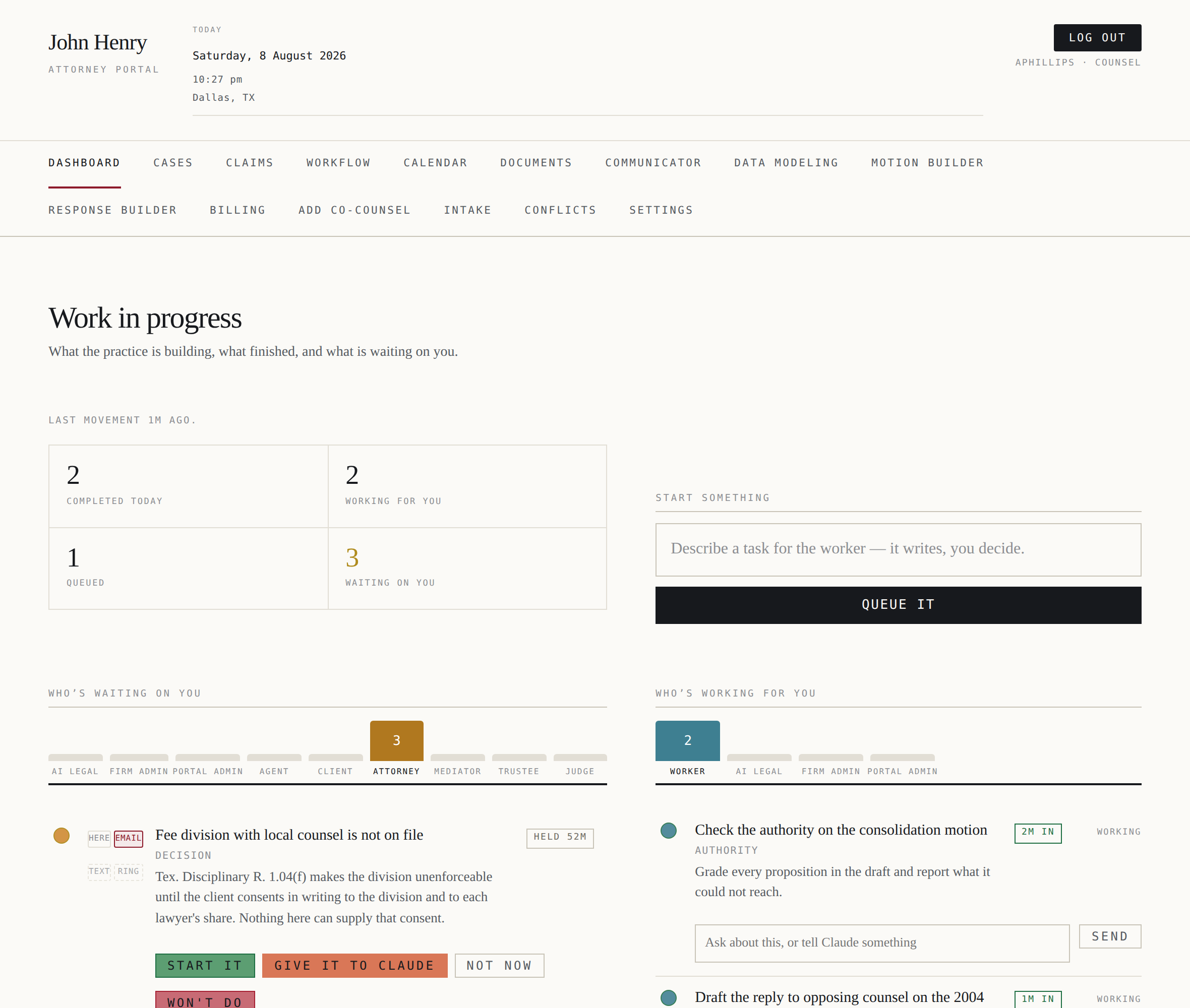
An agent working your matter is signed in, on a clock, and answerable inside the file. There is no separate report of work that happened somewhere else. If it is not in the record it did not happen, and the record is append-only.
Approving stamps your name and the time. Editing forks a new task rather than overwriting the old one. Work the system ran on its own is signed by nobody — deliberately — so what you commissioned and what it did alone can never be confused.
Unchecked is grey, and grey is never drawn as yellow. On the day the verification pass fails to run, the work looks exactly as unverified as it is — which is the one thing a confident tool will not tell you.
A colleague wants to hand you a case. To decide whether you want it you have to hear about it — and hearing about it is what disqualifies you. The referring lawyer builds the file on their side of a wall; you read eight fields, none of them prose, and choose a door.
DraftingBuild a motion from its elements, each carrying the source it rests on and the proof it needs. Then a pass grades every proposition in four colours — and grey, meaning nobody has read it, is the default and is never shown as yellow.
The fileEstates, matters, cases, claims, demands, appeals, judgments, rulings, intervenors — ten nouns over four tables, because a second table is where drift starts. An appeal has a parent. A judgment is a ruling that is final.
The registryWho EXISTS is shared; who is fighting whom is not. A name, an entity kind, a jurisdiction and a file number are public-register facts. That a party is in your case is client information and never leaves your firm.
TalkingEnd-to-end encrypted rooms, scoped to the people on the matter. A thread's audience is derived rather than picked, so an ex parte contact with the bench is not a rule the software follows — it is a thing the schema cannot represent.
TimeHuman minutes are billable. Model seconds are telemetry in a column the database refuses to let anyone sum into a bill. Categories are the 28 C.F.R. Pt. 58 App. A project set and the UTBMS codes, because one free-text category does not survive a US Trustee.
The boardOne renderer. The operator's board and yours are the same module with a different connection, so there is no private staging area where the good version lives. Every decision needing a human arrives as a row with a button on it.
EthicsRule 1.18 on prospective clients, 1.05 on client information, 1.04(f) on fee division, 5.04 on sharing fees, Ethics Op. 680 on cloud services, 705 and ABA 512 on billing AI. Each one is named where it bites, not gathered on a policy page.
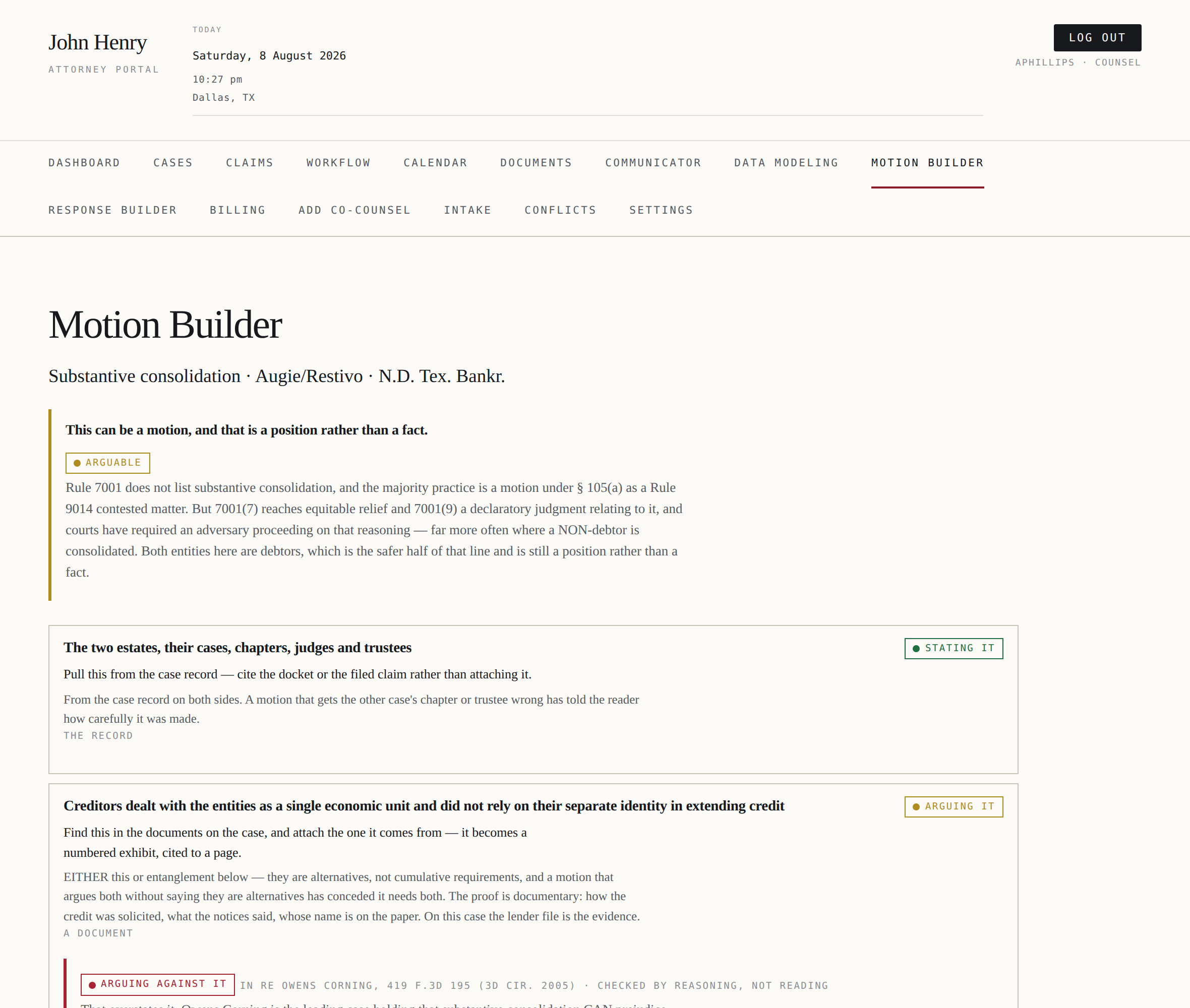
Every proposition a draft rests on gets a card. The card carries the citation, what it is being cited FOR, and a finding — and the finding is allowed to disagree with the brief.
On the right, the drafter has graded two elements themselves — stating it and arguing it — and the authority pass has come back underneath in red on the second one. Two grades, never merged: the chip is the lawyer's own assessment and the card below is what the check found, and overwriting one with the other would erase the disagreement, which is the single most interesting thing on the screen.

Here is that red card on its own. It is real output, from a motion for substantive consolidation. The proposition was written into the draft; the pass argued with it.
In re Owens Corning, 419 F.3d 195 (3d Cir. 2005)
“Nobody has checked this” and “a lawyer looked and found it open” are different claims. If unchecked rendered as yellow, then on the day the pass failed to run the motion would look exactly as careful as the day it worked.
That sentence is the whole argument for the Attorney Plug In, and it is not a feature claim — it is a fact about imputation.
The paralegal who reads the file is a person whose knowledge is imputed to the firm. A screen between that person and a partner is a policy enforced by memory, and it is worth precisely what the other side's disqualification motion says it is worth.
So when a colleague wants to hand you a matter, the ordinary way to find out whether you want it is to let them tell you about it — and Tex. Disciplinary R. 1.18(c) turns on what you RECEIVED, not on what you did with it. Here the referring lawyer answers a barrier agent on their own side of the database. You read eight fields, every one an enum or a band and not one of them prose, and you choose: look, take, or pass.
This is the list a managing partner should read first. Every entry is a refusal written into the code, not a limitation being managed.
There is no CM/ECF integration and there is no e-signature. Recording a motion as filed is a snapshot you take after you filed it yourself. A tool that files is a tool that can file the wrong thing at 4:59 on a Friday.
A model may assert a TEXT — a statute, a national rule — because you can confirm it in fifteen seconds against a free authoritative source. It may never settle what a case HELD. A case citation from a model pass tops out at arguable, and the ceiling is enforced where the card is stored rather than asked for in a prompt, because a rule a model is asked to follow is a rule it can fail to follow silently.
The research panel names the judges' standing procedures, the docket and the full text of the decisions, and says NOT CONNECTED beside each. A panel that lists only what a tool has tells you it consulted everything it has.
It returns a number of days and the rule the number came from, and where two local rules answer differently it shows both, because the comparison is the warning. Rule 9006 counting, service-method additions and court holidays are not modelled, and a date printed with confidence is one a lawyer stops re-checking.
A served pleading with no text layer is reported as probably a scan, which is not the same claim as the document being empty. The caption in a picture is a picture.
A response has no default posture, because a default of deny would make an untouched response read as a complete denial of everything. Whether a matter is core and whether you consent to entry of a final order are left blank — that is Stern v. Marshall, and it is a position, not a recital.
A citation graph proves that one case cited another on a date. It cannot tell overruled from distinguished from a string cite, and anything that renders a green flag off a citation count is the failure this whole system is built against.
Model seconds are stored as telemetry in a column the schema will not allow to be summed into a billable line — a generated column that cannot reference it, with a probe that fails the build if it ever does. ABA Formal Op. 512 and Tex. Ethics Op. 705 both hold that only human time is billable; here that is unrepresentable rather than documented.
There is one firm on it today and a second being onboarded. Access is opened deliberately, one practice at a time, because the first thing a new firm finds is always the thing nobody inside could see.