Mechanism 04
Arbitration waiver by substantial invocation
Can the other side still compel arbitration after litigating the case in Texas for months?
Often not. Under Perry Homes v. Cull, 258 S.W.3d 580 (Tex. 2008), a party waives arbitration by substantially invoking the judicial process, on a totality-of-the-circumstances test. One element has moved: Morgan v. Sundance, Inc., 596 U.S. 411 (2022), holds that waiver of an arbitration right under the Federal Arbitration Act does not require a showing of prejudice. In Murphy v. Liberty Hill Construction, LLC, Cause No. 25-0131-C26 (26th Judicial District Court, Williamson County), the plaintiffs refused a day-one offer to arbitrate, litigated eleven months, then moved to compel. The court found waiver and denied the motion.
By John P. Henry · Perry Homes v. Cull, 258 S.W.3d 580 (Tex. 2008) · Reviewed 2026-08-02
The authority
The Court finds that Plaintiffs substantially invoked the judicial process to LHC's detriment and prejudice and have waived their right to arbitration. The Plaintiffs' motion to compel arbitration is DENIED.Order Granting Final Summary Judgment, Cause No. 25-0131-C26, March 4, 2026
Perry Homes v. Cull, 258 S.W.3d 580 (Tex. 2008)
When it applies
Whenever an opponent with an arbitration clause chooses the courthouse first and reaches for the clause later — nearly always when discovery has gone badly or a dispositive motion is set. Waiver is decided on the totality of the circumstances, and the circumstances are their own docket.
How it is proved up
- Offer arbitration in writing at the outset, with an agreed order to abate already drafted and attached. The refusal is the first and best exhibit, and it only exists if it was created on day one.
- Build the record continuously: every motion they filed, every deposition they noticed, every discovery request they served, every setting they obtained, with dates.
- Quantify the detriment — fees and expenses incurred, discovery they obtained that arbitration would not have given them, and the delay itself.
- Preserve the objection in every responsive filing so the waiver argument is not itself waived.
What defeats it
- A short delay with little merits activity. Waiver requires substantial invocation, and courts start from a strong presumption against it.
- No showing of prejudice. Expense and delay alone are frequently held insufficient without more.
- A clause delegating arbitrability to the arbitrator, which can move the waiver question out of court — though litigation-conduct waiver is generally decided by the court.
Where I have used it
Murphy — arbitration was offered on day one with an agreed order to abate already drafted. They refused, litigated eleven months, then moved to compel. Denied.
The order
Exhibit — as signed
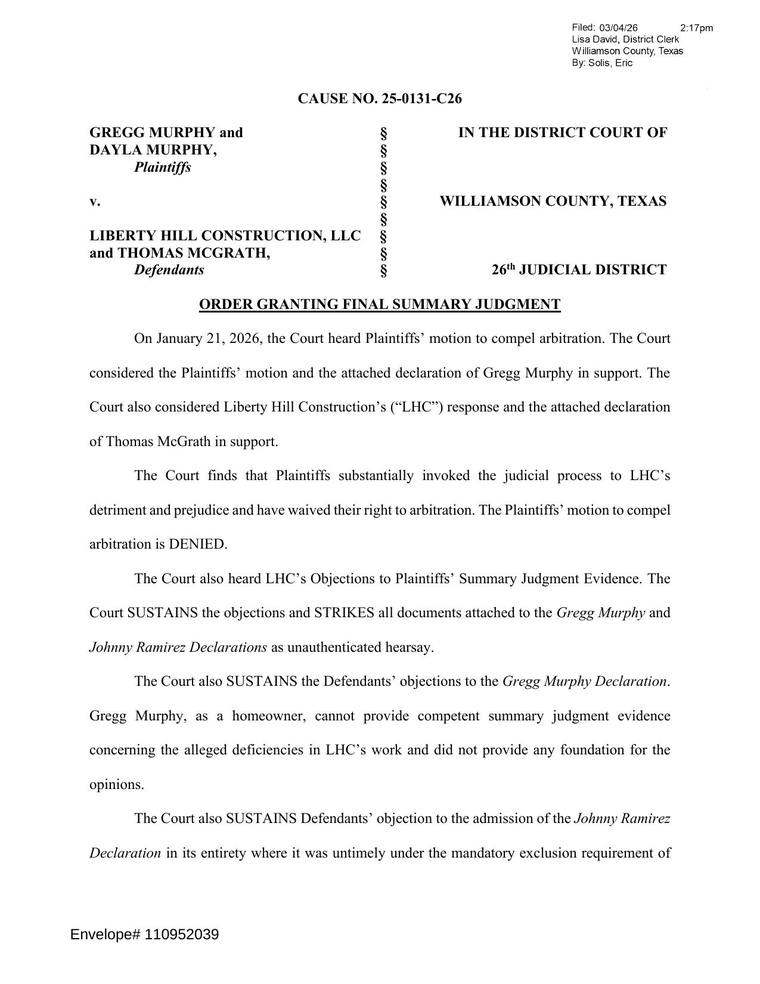
Order Granting Final Summary Judgment · March 4, 2026 — arbitration denied on waiver
CAUSE NO. 25-0131-C26 GREGG MURPHY and DAYLA MURPHY, Plaintiffs v. LIBERTY HILL CONSTRUCTION, LLC and THOMAS MCGRATH, Defendants IN THE DISTRICT COURT OF WILLIAMSON COUNTY, TEXAS 26th JUDICIAL DISTRICT ORDER GRANTING FINAL SUMMARY JUDGMENT On January 21, 2026, the Court heard Plaintiffs' motion to compel arbitration. The Court considered the Plaintiffs' motion and the attached declaration of Gregg Murphy in support. The Court also considered Liberty Hill Construction's ("LHC") response and the attached declaration of Thomas McGrath in support. The Court finds that Plaintiffs substantially invoked the judicial process to LHC's detriment and prejudice and have waived their right to arbitration. The Plaintiffs' motion to compel arbitration is DENIED. The Court also heard LHC's Objections to Plaintiffs' Summary Judgment Evidence. The Court SUSTAINS the objections and STRIKES all documents attached to the Gregg Murphy and Johnny Ramirez Declarations as unauthenticated hearsay. The Court also SUSTAINS the Defendants' objections to the Gregg Murphy Declaration. Gregg Murphy, as a homeowner, cannot provide competent summary judgment evidence concerning the alleged deficiencies in LHC's work and did not provide any foundation for the opinions. The Court also SUSTAINS Defendants' objection to the admission of the Johnny Ramirez Declaration in its entirety where it was untimely under the mandatory exclusion requirement of […] [Page 1 ends. Transcript continues on the following page of the order.]
Transcribed verbatim from the file-stamped copy. Public record. Reproduced because a result a reader can verify is worth more than a result described.
Questions
What is 'substantial invocation of the judicial process' in Texas?
Conduct inconsistent with an intent to arbitrate — filing and pursuing merits motions, conducting full discovery, obtaining trial settings, seeking relief the arbitrator could have given. Perry Homes directs a totality-of-the-circumstances review rather than a checklist.
Does delay alone waive the right to arbitrate?
No. Texas courts require both substantial invocation and resulting prejudice to the opposing party. Delay is one factor among several, and it is rarely sufficient standing alone.
How do you preserve a waiver argument against a late motion to compel arbitration?
Document the offer and the refusal in writing at the outset, object in every responsive filing, and keep a running record of the opponent's litigation conduct and of the fees and discovery burden it caused. The waiver is proved from their docket, not from argument.