Mechanism 02
No-evidence summary judgment
Can a no-evidence summary judgment be used offensively against affirmative defenses in Texas?
Yes. A no-evidence motion can be aimed at any element on which the opposing party bears the burden of proof — which includes their affirmative defenses. It removes the defense case before the merits are reached. In Aramcor v. Tri Marsh Retail LLC the court granted it against all four pleaded defenses: accord and satisfaction, lack of consideration, lack of contractual privity, and the Statute of Frauds.
By John P. Henry · Tex. R. Civ. P. 166a(h)(3) · Reviewed 2026-08-02
The authority
The court must grant a no-evidence motion unless the respondent produces summary judgment evidence raising a genuine issue of material fact.Tex. R. Civ. P. 166a(h)(3), effective March 1, 2026
Tex. R. Civ. P. 166a(h)(3)
When it applies
After an adequate time for discovery, against any claim or defense the other side must prove. Most useful where a defendant has pleaded a stack of boilerplate affirmative defenses it never intended to support with evidence — which is most defendants.
How it is proved up
- Specify the elements. A motion that says 'there is no evidence of Defendant's defenses' is a general no-evidence motion and is void. Each defense gets its own heading and each element is named.
- Establish that adequate time for discovery has passed — the level of the discovery control plan, the discovery deadline, and what was actually served and answered.
- File no evidence with it. Attaching evidence to a no-evidence motion invites the argument that the movant assumed a burden it does not have. Keep the traditional motion and its evidence in a separate instrument.
- Pair it with objections to whatever the response attaches, so the evidence that would raise the scintilla is struck before the court weighs it.
What defeats it
- More than a scintilla on the challenged element. The bar is low, so the motion works best against defenses that were pleaded reflexively and never developed.
- A motion that fails to identify elements with specificity.
- A showing under Rule 166a(d)(3) that the respondent cannot yet present facts essential to its opposition. That provision replaced the old 166a(g) continuance, and the relief menu is different — the court may extend the response deadline, deny the motion without prejudice to permit further discovery, or enter another appropriate order. It no longer uses the word continuance.
Where I have used it
Aramcor v. Tri Marsh — granted against all four affirmative defenses. Murphy v. Liberty Hill Construction, LLC and McGrath — combined with traditional grounds across all eight causes of action.
The order
Exhibit — as signed
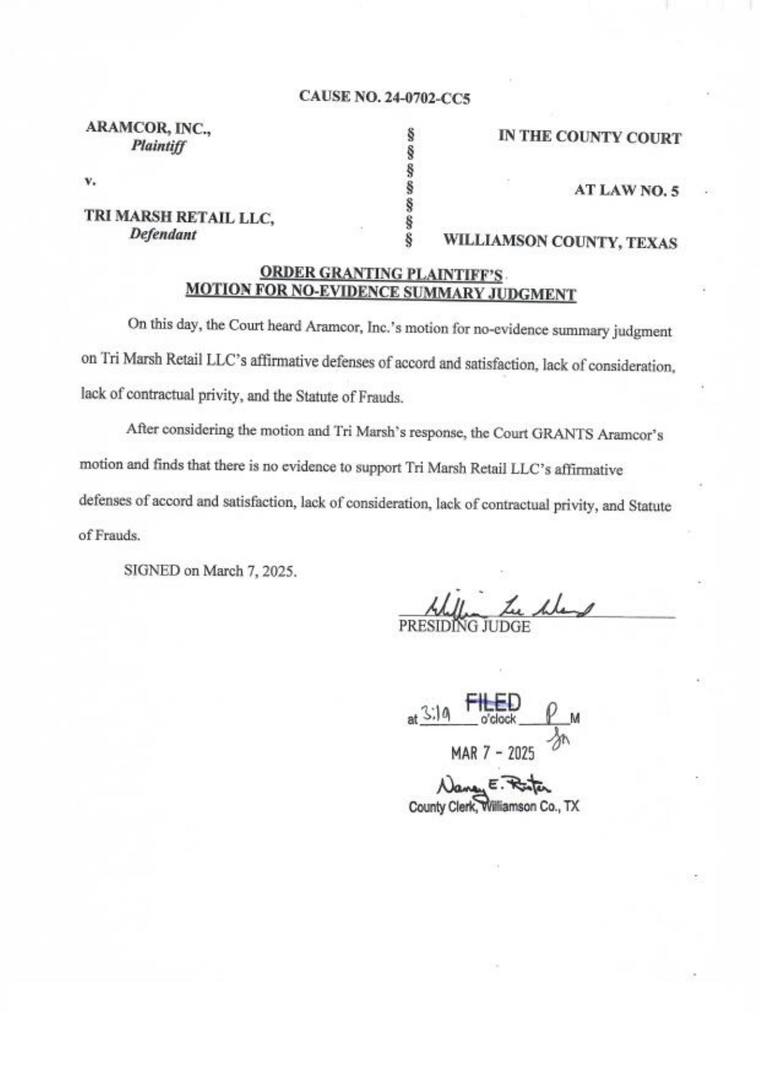
Order Granting Plaintiff's No-Evidence Motion for Summary Judgment · signed March 7, 2025
CAUSE NO. 24-0702-CC5 ARAMCOR, INC., Plaintiff v. TRI MARSH RETAIL LLC, Defendant IN THE COUNTY COURT AT LAW NO. 5 WILLIAMSON COUNTY, TEXAS ORDER GRANTING PLAINTIFF'S MOTION FOR NO-EVIDENCE SUMMARY JUDGMENT On this day, the Court heard Aramcor, Inc.'s motion for no-evidence summary judgment on Tri Marsh Retail LLC's affirmative defenses of accord and satisfaction, lack of consideration, lack of contractual privity, and the Statute of Frauds. After considering the motion and Tri Marsh's response, the Court GRANTS Aramcor's motion and finds that there is no evidence to support Tri Marsh Retail LLC's affirmative defenses of accord and satisfaction, lack of consideration, lack of contractual privity, and Statute of Frauds. SIGNED on March 7, 2025. _______________________________ PRESIDING JUDGE
Transcribed verbatim from the file-stamped copy. Public record. Reproduced because a result a reader can verify is worth more than a result described.
Questions
Can a plaintiff file a no-evidence motion for summary judgment in Texas?
Yes. The rule turns on who carries the burden of proof, not on who filed the suit. A plaintiff may move on the elements of a defendant's affirmative defenses or counterclaims.
What is 'adequate time for discovery' for a no-evidence motion in Texas?
There is no fixed period. Courts look to the nature of the case, the discovery control plan, the discovery already conducted, the deadlines, and whether the responding party diligently pursued discovery. Reciting the actual discovery history in the motion is what makes the showing.
Does a no-evidence motion have to identify specific elements?
Yes. Rule 166a(b)(2)(D) requires the motion to state the elements as to which there is no evidence — the specificity requirement that used to sit in 166a(i) is now express in the text. A general no-evidence challenge is insufficient and is subject to being treated as void.
Is a no-evidence motion still filed under Rule 166a(i)?
No, and this is the citation most likely to go wrong. Since the March 1, 2026 rewrite the no-evidence motion is defined at 166a(a)(2), its contents are governed by 166a(b)(2)(D), its timing by 166a(b)(3)(B), and the standard by 166a(h)(3). Subsection (i) still exists — it now means Ruling, and requires the court to sign a written ruling within ninety days of the hearing or submission date. A stale cite to 166a(i) does not dangle; it points at a real provision about something else. Motions filed before March 1, 2026 remain governed by the former rule.