Mechanism 12
Striking a lay declaration for want of foundation
Can a homeowner testify that construction work was defective without an expert?
Not as to defect. Under Tex. R. Evid. 701, a lay witness may testify to what he perceived, but opinions requiring specialized knowledge belong to a qualified expert under Rule 702. In Murphy v. Liberty Hill Construction, the court held that the homeowner “as a homeowner, cannot provide competent summary judgment evidence concerning the alleged deficiencies in LHC's work and did not provide any foundation for the opinions.”
By John P. Henry · Tex. R. Evid. 701 & 702 · Reviewed 2026-08-02
The authority
The Court also SUSTAINS the Defendants' objections to the Gregg Murphy Declaration. Gregg Murphy, as a homeowner, cannot provide competent summary judgment evidence concerning the alleged deficiencies in LHC's work and did not provide any foundation for the opinions.Order Granting Final Summary Judgment, Cause No. 25-0131-C26, March 4, 2026
Tex. R. Evid. 701 & 702
When it applies
Construction defect, professional negligence, valuation, causation, medical condition — any subject where the conclusion depends on training rather than observation. Most commonly it appears as a party declaration attached to a summary judgment response, doing work the party never designated an expert to do.
How it is proved up
- Object sentence by sentence, not to the declaration as a whole. Global objections invite a global overruling.
- Separate what he saw from what he concluded. Cracks, water, a gap — observations, admissible. 'Improperly framed,' 'not to code,' 'will cost $X to repair' — opinion, excluded.
- Show the absence of foundation affirmatively: no trade experience, no inspection methodology, no designation as an expert.
- Get a written order sustaining the objections, then show that what survives cannot raise a fact issue.
What defeats it
- Genuinely lay observations, which come in and may be enough on a simpler element.
- A witness with actual trade experience — an owner who is also a builder is a different problem.
- Failure to obtain a ruling. An objection without an order preserves nothing.
Where I have used it
Murphy — the homeowner's declaration struck; a lay witness cannot opine on construction defects without foundation.
The order
Exhibit — as signed
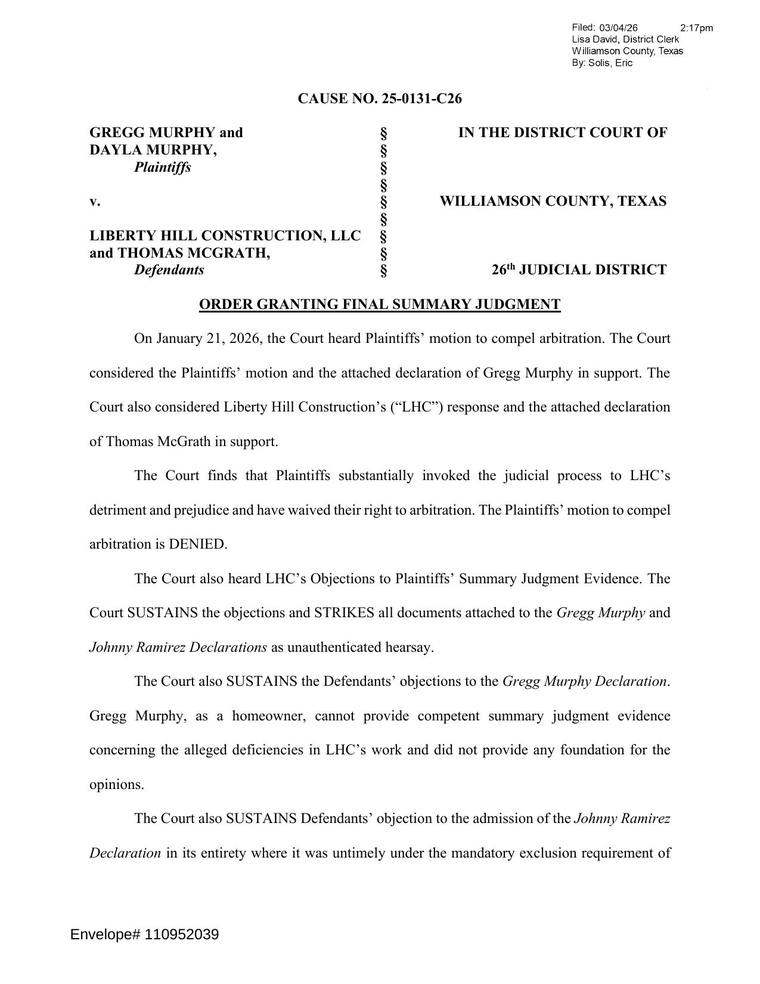
Order Granting Final Summary Judgment · March 4, 2026 — lay declaration struck for want of foundation
CAUSE NO. 25-0131-C26 GREGG MURPHY and DAYLA MURPHY, Plaintiffs v. LIBERTY HILL CONSTRUCTION, LLC and THOMAS MCGRATH, Defendants IN THE DISTRICT COURT OF WILLIAMSON COUNTY, TEXAS 26th JUDICIAL DISTRICT ORDER GRANTING FINAL SUMMARY JUDGMENT On January 21, 2026, the Court heard Plaintiffs' motion to compel arbitration. The Court considered the Plaintiffs' motion and the attached declaration of Gregg Murphy in support. The Court also considered Liberty Hill Construction's ("LHC") response and the attached declaration of Thomas McGrath in support. The Court finds that Plaintiffs substantially invoked the judicial process to LHC's detriment and prejudice and have waived their right to arbitration. The Plaintiffs' motion to compel arbitration is DENIED. The Court also heard LHC's Objections to Plaintiffs' Summary Judgment Evidence. The Court SUSTAINS the objections and STRIKES all documents attached to the Gregg Murphy and Johnny Ramirez Declarations as unauthenticated hearsay. The Court also SUSTAINS the Defendants' objections to the Gregg Murphy Declaration. Gregg Murphy, as a homeowner, cannot provide competent summary judgment evidence concerning the alleged deficiencies in LHC's work and did not provide any foundation for the opinions. The Court also SUSTAINS Defendants' objection to the admission of the Johnny Ramirez Declaration in its entirety where it was untimely under the mandatory exclusion requirement of […] [Page 1 ends. Transcript continues on the following page of the order.]
Transcribed verbatim from the file-stamped copy. Public record. Reproduced because a result a reader can verify is worth more than a result described.
Questions
What is the difference between Rule 701 and Rule 702 opinion testimony?
Rule 701 permits a lay witness to give opinions rationally based on his own perception and helpful to the factfinder, so long as they are not based on scientific, technical or other specialized knowledge. Once specialized knowledge is required, Rule 702 and its qualification and reliability requirements apply.
Do objections to summary judgment evidence have to be ruled on?
Objections to the form of summary judgment evidence must be preserved by obtaining a ruling. The safer practice is always to secure a written order, which is also what makes the exclusion reviewable.
Can a property owner testify to the value of his own property in Texas?
The property owner rule permits an owner to testify to the value of his property, but the testimony must still be based on market value rather than intrinsic or personal value, and it does not extend to technical opinions about defects or causation.