Mechanism 01
Traditional summary judgment
When can a Texas plaintiff win a breach-of-contract case on traditional summary judgment?
A traditional summary judgment ends a case when the movant proves every element of its claim with competent evidence and no genuine issue of material fact remains. On a written contract with a liquidated sum, that is usually achievable. In Aramcor, Inc. v. Tri Marsh Retail LLC, Cause No. 24-0702-CC5, the court granted it in full the day of the contested hearing — $44,658.57 in damages plus $28,929.12 in fees.
By John P. Henry · Tex. R. Civ. P. 166a(h)(2) · Reviewed 2026-08-02
The authority
The court must grant a traditional motion for summary judgment if the movant shows that, except as to the amount of damages, there is no genuine issue as to any material fact and the movant is entitled to judgment as a matter of law on the issues expressly set out in the motion.Tex. R. Civ. P. 166a(h)(2), effective March 1, 2026
Tex. R. Civ. P. 166a(h)(2)
When it applies
A signed instrument, a definite sum, and a defendant whose defense is argument rather than evidence. Leases, notes, guaranties, sworn accounts and CAM reconciliations are the natural habitat. The motion is available to a plaintiff on its own claim and to a defendant on an affirmative defense conclusively established.
How it is proved up
- A business-records affidavit that actually satisfies Tex. R. Evid. 902(10) — custodian, personal knowledge, made at or near the time, kept in the regular course. Most affidavits that fail, fail here.
- The instrument itself, attached and authenticated, with every amendment and assignment in the chain.
- A damages calculation a judge can follow line by line without doing arithmetic. If the number cannot be tied to a document, it is not liquidated and the motion is the wrong vehicle.
- Segregated attorney's fees supported by a declaration that does the Rohrmoos work — hours, rate, task — rather than asserting a total.
- Objections to the response's evidence filed and set at the same hearing, so the record is clean before the merits are argued. The 2026 rewrite says nothing about objections — no deadline, no requirement that the court rule on them — so the burden of getting a ruling is still entirely yours.
- For a motion filed on or after March 1, 2026: the title. Rule 166a(b)(2)(A) requires the motion to be titled Traditional, No-Evidence, or Combined, and an oral hearing has to be requested in the title itself. A wrong title is expressly not grounds for denial, but the hearing request is easy to lose.
- Discovery not already on file must be tendered with the motion, not twenty-one days before a hearing. Rule 166a(j)(3)(A) moved that deadline forward, and it is the one most likely to catch a practitioner working from an old form file.
What defeats it
- A scintilla of evidence on any element. The standard is not preponderance; it is whether a fact issue exists at all.
- A conclusory or defective business-records affidavit, which takes the entire damages proof with it.
- An affirmative defense the movant did not negate. A plaintiff's traditional motion does not dispose of pleaded defenses unless it addresses them, which is why the no-evidence motion travels with it.
- Fees left unsegregated between recoverable and unrecoverable claims.
Where I have used it
Aramcor, Inc. v. Tri Marsh Retail LLC · Cause No. 24-0702-CC5, County Court at Law No. 5, Williamson County. Granted in full — liquidated damages, fees and post-judgment interest — the day of the contested hearing.
The order
Exhibit — as signed
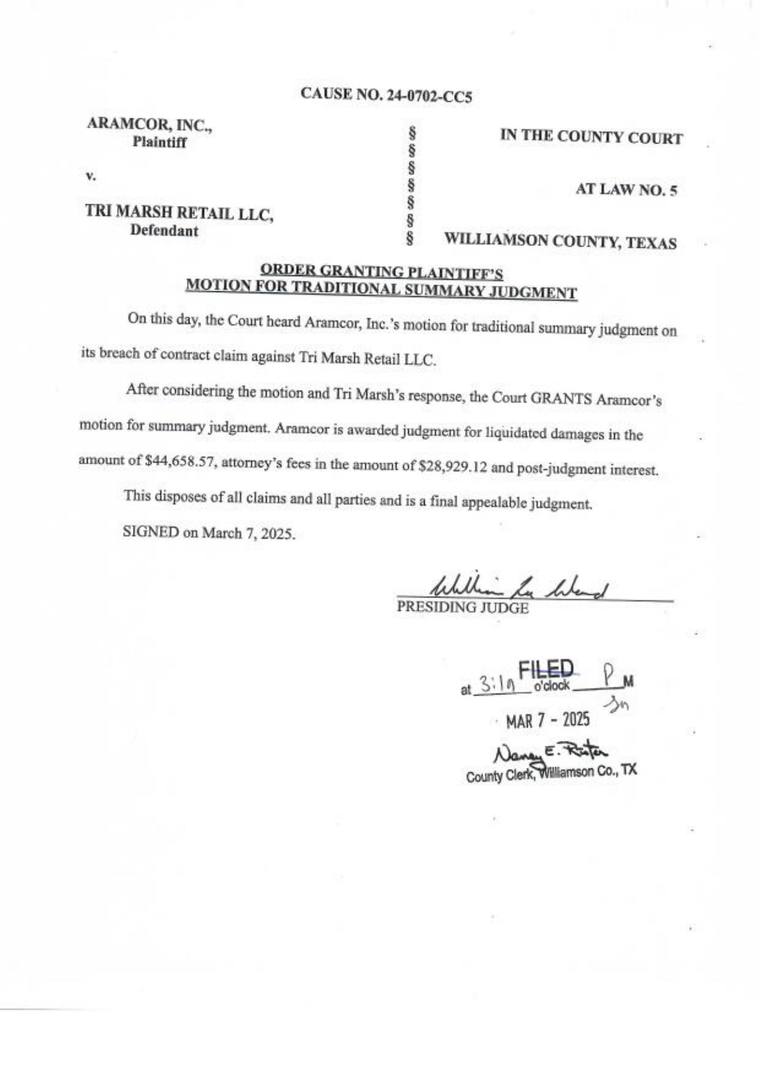
Order Granting Plaintiff's Motion for Traditional Summary Judgment · signed March 7, 2025
CAUSE NO. 24-0702-CC5 ARAMCOR, INC., Plaintiff v. TRI MARSH RETAIL LLC, Defendant IN THE COUNTY COURT AT LAW NO. 5 WILLIAMSON COUNTY, TEXAS ORDER GRANTING PLAINTIFF'S MOTION FOR TRADITIONAL SUMMARY JUDGMENT On this day, the Court heard Aramcor, Inc.'s motion for traditional summary judgment on its breach of contract claim against Tri Marsh Retail LLC. After considering the motion and Tri Marsh's response, the Court GRANTS Aramcor's motion for summary judgment. Aramcor is awarded judgment for liquidated damages in the amount of $44,658.57, attorney's fees in the amount of $28,929.12 and post-judgment interest. This disposes of all claims and all parties and is a final appealable judgment. SIGNED on March 7, 2025. _______________________________ PRESIDING JUDGE
Transcribed verbatim from the file-stamped copy. Public record. Reproduced because a result a reader can verify is worth more than a result described.
Questions
What is the standard for traditional summary judgment in Texas?
The movant must show there is no genuine issue of material fact and that it is entitled to judgment as a matter of law. Evidence is viewed in the light most favorable to the non-movant, and every reasonable inference is indulged in the non-movant's favor.
How is traditional summary judgment different from no-evidence summary judgment?
A traditional motion carries an affirmative burden — the movant proves its own case with evidence. A no-evidence motion carries no evidentiary burden — it identifies an element the other side cannot support and shifts the burden to them. They are routinely filed together, and the current rule expressly contemplates a combined motion.
Which version of Rule 166a applies to my summary judgment motion?
The one in force when the motion was filed. Rule 166a was rewritten by Misc. Docket No. 26-9012, effective March 1, 2026, and the order provides that the amendments apply only to a motion filed on or after that date. A motion filed before it is still governed by the former rule, so a case pending across the changeover can have one motion under each.
Where did Rule 166a(c) go?
Traditional summary judgment is now defined at Rule 166a(a)(1), its required contents are at 166a(b)(2)(C), and the standard is at 166a(h)(2). The lettering matters more than usual here, because the rewrite reused the old letters for new subjects — 166a(c) is now Clerk and Court Duties Upon Filing. A brief that still cites 166a(c) for the traditional standard is citing a live provision about something else. One trap to know about: the 1990 and 1997 Comments were carried into the rewritten rule unchanged, so the official Comment still cross-references paragraphs (a), (b), (c) and (i) by their former meanings. Following the Comment's own citations lands you in the wrong subsection.
Can attorney's fees be awarded on summary judgment in Texas?
Yes, where a statute or contract provides for them and the proof satisfies Rohrmoos Venture v. UTSW DVA Healthcare. In Aramcor v. Tri Marsh the court awarded $28,929.12 in fees in the same order as the damages.