Mechanism 40
Partial default that preserves the case
Can I take a default judgment against one defendant and keep the case alive against the others?
Yes, but the judgment has to say so. An interlocutory default may be taken against a defendant who has not answered while the case proceeds against the rest — and the order must state expressly that it does not dispose of all claims and all parties. Without that recital a court may treat it as final, start the appellate clock, and take the remainder of the case with it.
By John P. Henry · Tex. R. Civ. P. 239, 240 · Reviewed 2026-08-02
The authority
Where there are several defendants, some of whom have made default … the plaintiff may discontinue as to the defendants so making default and take judgment against those who have answered, or may take judgment against those who have made default. — Tex. R. Civ. P. 240, in substanceTex. R. Civ. P. 239, 240
Tex. R. Civ. P. 239, 240
When it applies
Multi-defendant collection suits — a tenant entity, several guarantors, prior assignors still liable on the lease, and one defendant who has moved out of state and will not appear.
How it is proved up
- Perfect service and prove it. A default is only as good as the return, and an out-of-state defendant means long-arm service under the Civil Practice and Remedies Code with the requisite jurisdictional allegations pleaded.
- Prove damages by affidavit even on a liquidated claim, with the instrument attached.
- Include the express non-disposition recital: this judgment does not dispose of all claims and all parties and is interlocutory.
- Segregate the defaulting defendant's liability from the others so the judgment can stand alone.
- Check the servicemembers affidavit and the last-known-address certificate before presenting it.
What defeats it
- Defective service, which is the single most common reason defaults are set aside.
- A timely motion for new trial under the Craddock standard.
- Omitting the non-disposition language, which can convert the order into a final judgment by operation of the finality presumption.
Where I have used it
Restaurant tenant, six co-defendants and two third-party defendants, County Court at Law No. 4. Default taken against the one defendant who had moved out of state — $61,207.41 plus $3,375 in fees, signed and file-stamped — while the answering parties settled for $20,000, receipted. Demands had gone not only to the tenant and guarantors but to prior assignors still liable on the lease.
The order
Exhibit — as signed
Partial Default Judgment · Williamson County · Cause No. 11-0982-CC4 · signed and file-stamped February 7, 2012
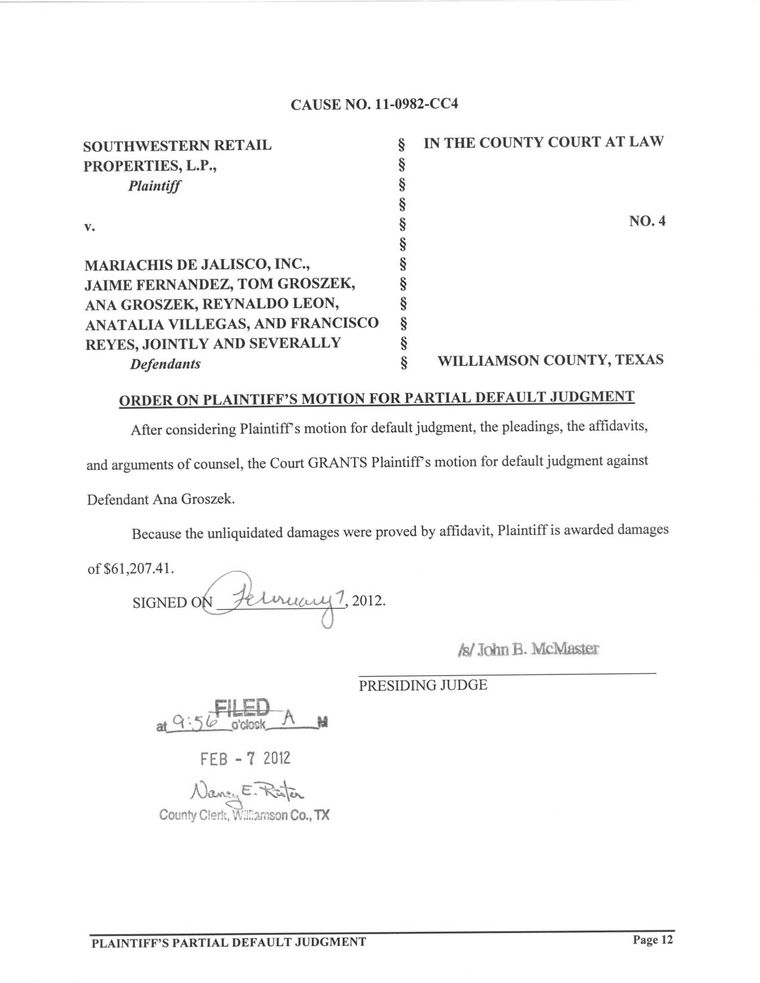
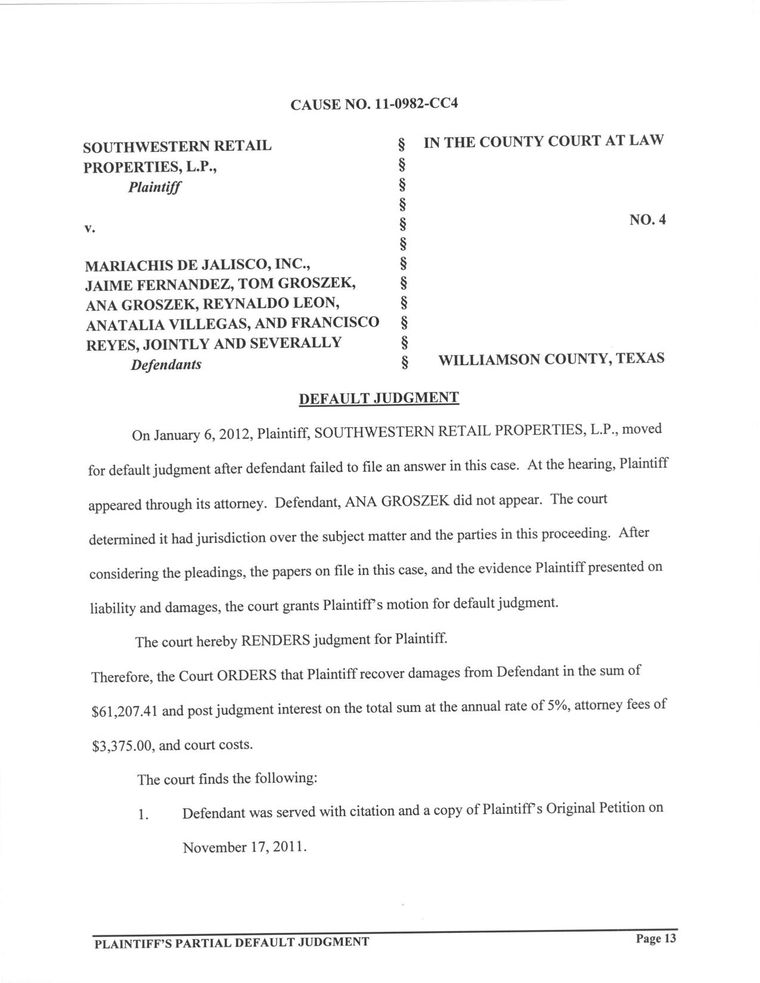
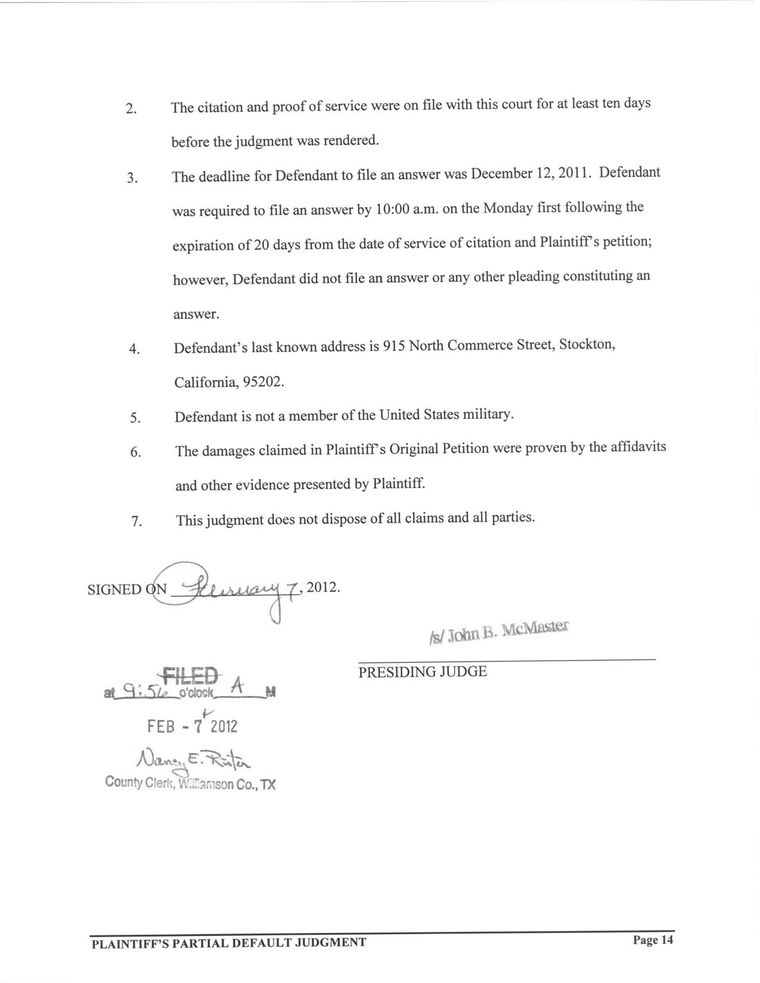
CAUSE NO. 11-0982-CC4 SOUTHWESTERN RETAIL PROPERTIES, L.P., Plaintiff v. MARIACHIS DE JALISCO, INC., JAIME FERNANDEZ, TOM GROSZEK, ANA GROSZEK, REYNALDO LEON, ANATALIA VILLEGAS, AND FRANCISCO REYES, JOINTLY AND SEVERALLY, Defendants IN THE COUNTY COURT AT LAW NO. 4 WILLIAMSON COUNTY, TEXAS ORDER ON PLAINTIFF'S MOTION FOR PARTIAL DEFAULT JUDGMENT After considering Plaintiff's motion for default judgment, the pleadings, the affidavits, and arguments of counsel, the Court GRANTS Plaintiff's motion for default judgment against Defendant Ana Groszek. Because the unliquidated damages were proved by affidavit, Plaintiff is awarded damages of $61,207.41. SIGNED ON February 7, 2012. /s/ John B. McMaster PRESIDING JUDGE [Second instrument, same cause and same day] DEFAULT JUDGMENT On January 6, 2012, Plaintiff, SOUTHWESTERN RETAIL PROPERTIES, L.P., moved for default judgment after defendant failed to file an answer in this case. At the hearing, Plaintiff appeared through its attorney. Defendant, ANA GROSZEK did not appear. The court determined it had jurisdiction over the subject matter and the parties in this proceeding. After considering the pleadings, the papers on file in this case, and the evidence Plaintiff presented on liability and damages, the court grants Plaintiff's motion for default judgment. The court hereby RENDERS judgment for Plaintiff. Therefore, the Court ORDERS that Plaintiff recover damages from Defendant in the sum of $61,207.41 and post judgment interest on the total sum at the annual rate of 5%, attorney fees of $3,375.00, and court costs. The court finds the following: 1. Defendant was served with citation and a copy of Plaintiff's Original Petition on November 17, 2011. 2. The citation and proof of service were on file with this court for at least ten days before the judgment was rendered. 3. The deadline for Defendant to file an answer was December 12, 2011. Defendant was required to file an answer by 10:00 a.m. on the Monday first following the expiration of 20 days from the date of service of citation and Plaintiff's petition; however, Defendant did not file an answer or any other pleading constituting an answer. 4. Defendant's last known address is 915 North Commerce Street, Stockton, California, 95202. 5. Defendant is not a member of the United States military. 6. The damages claimed in Plaintiff's Original Petition were proven by the affidavits and other evidence presented by Plaintiff. 7. This judgment does not dispose of all claims and all parties. SIGNED ON February 7, 2012. /s/ John B. McMaster PRESIDING JUDGE
Transcribed verbatim from the file-stamped copy. Public record. Reproduced because a result a reader can verify is worth more than a result described.
Questions
Is a partial default judgment final in Texas?
Not if it says it is not. A judgment is final for appeal if it disposes of all claims and all parties or states with unmistakable clarity that it is final. An interlocutory default should expressly recite that it does not dispose of all claims and parties.
What is the Craddock standard for setting aside a default?
A default will be set aside where the failure to answer was not intentional or the result of conscious indifference but was due to accident or mistake, the motion sets up a meritorious defense, and granting it will occasion no delay or injury to the plaintiff.
Do damages have to be proved on a default judgment in Texas?
Unliquidated damages must be proved. Even on a liquidated claim, presenting an affidavit with the underlying instrument is the practice that survives a motion for new trial.